Pirogov First Volunteer Mobile Hospital
Вітаємо побратима! Хірургу ПДМШ Олександру Ткаченку присвоєно звання «Заслужений лікар України»
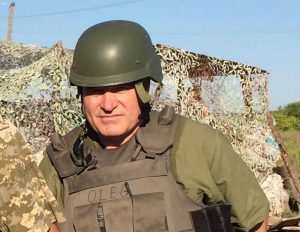
Напередодні професійного свята медиків лікар Першого добровольчого мобільного шпиталю ім. Миколи Пирогова хірург Олександр Ткаченко був нагороджений почесним званням «Заслужений лікар України». Про це, зокрема, йдеться в Указі Президента України №162/2017 «Про відзначення державними нагородами України з нагоди Дня медичного працівника». Згідно з Указом, медиків відзначено «за значний особистий внесок у розвиток вітчизняної системи охорони здоров’я, надання кваліфікованої медичної допомоги та високу професійну майстерність». (more…)
Volunteer and Government Commissioner
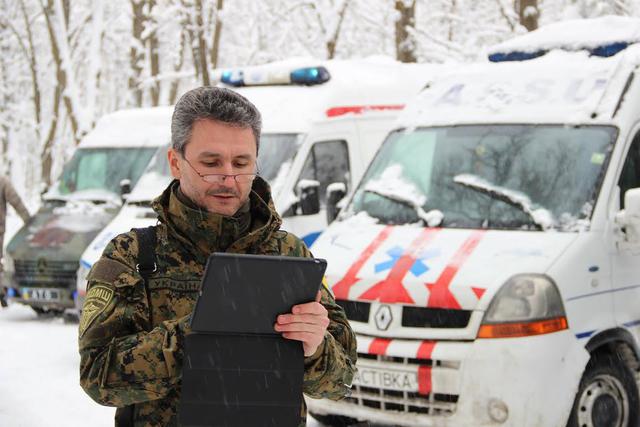
Interview with Gennadiy Druzenko, cofounder and Board of Trustees chairman of the Pirogov First Volunteer Mobile Hospital
By Kateryna Samoylenko
(Published on CENSOR.NET, updated. Photos: CENSOR.NET)
The “golden hour” is a key term in the military medicine. It means the time span during which qualified medical aid must be provided to a wounded warrior, and the vital functions of his body stabilized. As minutes pass, his chance for not only effective treatment of his wound but even the very survival gets slimmer. According to the chairman of the Pirogov First Volunteer Mobile Hospital Board of Trustees, Gennadiy Druzenko, 80% of fatalities in the Anti-Terrorist Operation (ATO) result from failure to provide timely medical care. He says the reason for this is the lack of properly equipped hospitals (some having been destroyed or damaged) and skilled doctors, first and foremost surgeons, within dozens of kilometers from the battlefield. The Pirogov First Volunteer Mobile Hospital (PFVMH) was established in order to provide timely and effective medical aid to wounded warriors and civilian residents in the ATO zone. Mr. Druzenko explains the hospital’s structure and operation mode.


From which moment does the PFVMH history begin?
On the eve of Dec. 1, 2013, I together with my friends initiated, through Facebook, the formation of volunteer mobile medical teams that provided first aid to participants in the Revolution of Dignity who were injured in the clashes with the special forces units of the Interior Ministry, the Berkut, on Bankova Street. This is how lawyer Gennadiy Druzenko got involved in medicine. In January and February 2014, my friends and I organized voluntary – actually underground – hospitals, which have provided care to over 150 patients including those with gunshot wounds. And in March, having launched a Ukrainian Reserve Army initiative, we worked, among other things, on developing the skills of battlefield medical aid at the Sniper shooting range near Kyiv.
After learning of the terrible statistics of our losses in Illovaysk, when every third wound led to a lethal outcome (for comparison: during WWII, every fifth wounded died, and the current NATO fatality rate standard is 3%), we decided that we had to do something. We analyzed causes of such an unacceptably high fatality rate among our wounded warriors. The conclusion we reached was that rather than bringing the wounded to skilled doctors (sometimes several hundred kilometers over terrible Ukrainian roads), highly skilled doctors and advanced equipment should be delivered as close to the frontline as possible. In other words, as close as allowed by safety considerations, because it takes 10 years to train a doctor and 10 seconds to lose him or her.


And so we started setting up the Pirogov First Volunteer Mobile Hospital: recruiting doctors and training them in special skills of tactical medicine, looking for state-of-the-art mobile equipment, buying evacuation vehicles, and assembling mobile operating rooms on wheels. Simultaneously we also were drafting a legal framework for hospital operations, which was unique for a volunteer project. In a month we signed a memorandum of cooperation under the project with the Defense Ministry, in a month and a half we made the first public presentation of the hospital, and in three months we had a memorandum of cooperation with the Health Ministry and its order on the establishment of a Composite Disaster Medicine Party on the basis of the PFVMH. In three and a half months, in December 2014, our hospital went on its first mission to Kurakhove, a small town 25 kilometers from Donetsk.

The name First Volunteer Mobile Hospital suggests that the doctors working in this association are volunteers, not army doctors.
Precisely. The PFVMH is a nongovernmental initiative, and presently the largest and most systemic volunteer project involving civilian medics in the provision of medical aid in the ATO zone. The only thing in which we differ from classical volunteers is that our medical volunteers obtain a business trip authorization from their employers for work in the Donetsk and Luhansk oblasts. On the one hand, the authorization secures them from being fired as AWOL, and on the other hand, it gives them legal grounds to work as members of the Composite Disaster Medicine Party based on local hospitals.
By the way, we provide care to not only servicemen but also to civilians – totally free of charge. In the beginning, this even surprised local residents and aroused suspicions: unfortunately, free and high-quality medical services, let alone free medicines, are for most Ukrainians something from the world of dreams and fairy tales.
And here we willy-nilly act as healers of not only physical diseases but also the virus of separatism, since our hospital is seen by the locals as one of few manifestations of real care for them of Kyiv authorities. The people in Donbas are like small children: they have grown accustomed to being taken care of by somebody. And therefore our medical aid quite often melts the old snowbanks of distrust of the central government and shatters the myths about the “junta” and “banderites” from Great Ukraine better than any information ministry would do.

A nongovernmental project? Then where do your funds come from?
The funds come from donations and sponsors’ assistance. For example, once we had to find urgently ₴60,000 plus to pay a company for converting an Ural truck into an operating-room vehicle. Over the day, we managed to collect from people familiar and unfamiliar about ₴10,000. I had already started to despair when, all of a sudden, a friend of mine, an artist, phoned me and said that a monk of one of Kyiv’s monasteries – by the way, of the Moscow Patriarchate – had a donation from an anonymous benefactor for a good cause. I rushed to the Trinity Monastery of St. Jonas, told them about our project, and they gave us a plastic bag of money, in which we found ₴100,000.
Sometimes people we know and don’t know donate several tens or hundreds of hryvnyas each, and sometimes serious enterprises, like, for example, our strategic partner Svarog West Group, give hundreds of thousands. Not long ago, the first contributions began flowing in from the Ukrainian diaspora in Europe. We are looking for assistance everywhere, because the development and very existence of our hospital completely depend on support from known and unknown benefactors. However, it has its advantage: since we have no financial rear, and neither the state budget nor oligarchs stand behind us, we are just destined to work better and more efficiently than the official medicine does – only in this case people will trust us and donate their hryvnyas, dollars and euros, sometimes hard-earned …
Was there a situation when you had to suspend your activities because of lack of money?
No, that has never happened. Several times we were on the brink of stopping but every time we found a way out from the strained circumstances. Though, sure, after our hospital has proven its efficiency, it would be good to receive at least partial financing from the state. If the state has a budget for procurement of medical services from non-state medical institutions and medicines from private producers, why not co-finance such projects as ours, the more so that we independently provide ourselves with transportation, medicines, and medical equipment? Probably, our only permanent headaches are fuel, without which all those evacuation and other special medical vehicles turn into an outdoor museum, repair and maintenance of these vehicles, which come to us far from being new, as well as the cost of utilities in the local hospitals at which our doctors work and typically reside.

Do you always have sufficient volunteers? Because a business trip authorization is only possible for a limited period of time, and then there should be a rotation and need to collect a new team.
For the time being, we do not experience lack of those willing to volunteer in our hospital. Though, of course, every so-called “truce” creates an illusion that everything is OK in Eastern Ukraine, and volunteers are needed there no more. Each of our missions comprises about 30 medical workers and auxiliaries, as well as a guard company provided to us by Dnipro-1, a unit of the Interior Ministry. Volunteers work in the ATO zone for 30 days (the maximum business trip duration allowed by the Health Ministry). Though we rotate the personnel every month, today we still have over 100 persons in reserve. I hope that their number will grow after this interview is published (laughing).
Generally speaking, the hospital has three management levels: (i) the Board of Trustees is responsible for strategic matters, such as collaboration with ministries and other authorities as well as international partners; (ii) the Staff, which functions as an executive directorate and so handles funds, is responsible for supply of medicines and equipment, organization of training for medics, and logistics; and (iii) the operative command of a mission – a party of doctors and auxiliaries who work at the frontline. Therefore, the PFVMH is a whole system that unites professionals in various fields of activities: from international relations and government relations to actual provision of skilled medical services to military people and civilian population in the ATO zone.
The main task of the PFVMH is to provide immediate care to wounded people, operate and stabilize their condition when necessary, and then bring them to a stationary military hospital or an oblast hospital in Kharkiv, Dnipropetrovsk, Zaporizhya or even Kyiv. Our fleet currently has 15 vehicles, including two unique mobile operating rooms, four C and B class resuscitation vehicles, a so-called tablette (UAZ 452), which is still most widespread ambulance in the Armed Forces of Ukraine, an armored vehicle (former cash-in-transit van), a few vehicles for transportation of personnel and load, and the baths on wheels – a great favorite of the troops.

So far we have been living and working, as a rule, at municipal and district hospitals; however, we can operate in the field as well, as a matter of fact. To deploy, we need not more than 30 minutes. But unlike, let’s say, Americans and British in Afghanistan, we are fighting on our own territory, so it would have been silly not to use the available infrastructure of civilian medicine, or rather what has been left of it. The cooperation with local doctors, receiving civilians, living next door to patients’ wards – five or six persons in a room – all this is an important message for Eastern Ukraine: we are together with you, we will not set Donbas adrift, this misfortune will only pull us together and toughen us.
The PFVMH volunteers work quite close to the site of immediate hostilities. On the average, it is 30 to 50 kilometers off, but now one of our groups of doctors works in the town of Popasna, Luhansk Oblast. It is the first line of defense. On a sunny day you can see not only our last checkpoint but also the first enemy checkpoint from the hospital’s windows. MLRS missiles will not come here: too close; but unfortunately, nobody is secured against an enemy mortar bomb or a sniper’s bullet. But how could we turn down the request from Luhansk Oblast Governor Hennadiy Moskal to lend a hand and come to work in Popasna, recently populated by 22,000, where the central district hospital is ruined by shells, most of its doctors ran away, and only seven staff members remained at the Railroad Hospital, which had survived?

Whether the conditions in which the doctors give treatment, carry out examinations and operate have an impact on the quality of work they perform?
The hospital was established to work in extreme conditions. All the medics are experts in their occupation, often ones of Ukraine’s best, and can perform very complicated operations despite absence of the comfort conditions they are accustomed to.
When the units of the Ukrainian Armed Forces were leaving the Debaltseve Foothold, the PFVMH worked on the base of the Artemivsk Central District Hospital. Our surgeons Vladyslav Horbovets and Stepan Krulko were the only ones who could do vascular prosthetic operations. For you to understand: the only alternative to such operations was amputation of limbs. So thanks to the PFVMH, there are warriors who will continue walking on their own legs, not prostheses.
Not surprisingly, as the chairman of the PFVMH Board of Trustees, I applied to the President of Ukraine with a motion to decorate these surgeons with medals “For Saving a Life.” We will wait and see what the response from the Head of State is. As far as I know, the Presidential Administration State Rewards Department has not yet prepared this question for consideration…
You mentioned three levels of hospital operation. Does it mean that for a similar project to function successfully, the willingness and enthusiasm of volunteers alone will not be enough, but it will also need support from above?
Yes, I believe that to be efficient and successful, the complex volunteer projects like the PFVMH need state support, and not only financial. For example, if you are not a local resident, you need legal grounds to be in the ATO zone. Therefore we agree on our location and involvement of the FVMH in provision of care to servicemen with the General Staff of the Armed Forces. To ensure that our volunteer doctors would legally work at local hospitals, we succeeded in making the Health Ministry issue a special order. In particular, this order bound the head of the Ukrainian Scientific and Practical Center for Emergency Medical Aid and Disaster Medicine to ensure inclusion of PFVMH both medical and non-medical personnel in the Health Ministry’s Composite Disaster Medicine Party. It also ensures cooperation of the Center with our hospital in manning it with medical personnel, rotating the personnel as prescribed, etc.

In the winter, we encountered the problem of having no rear base for our hospital to train and joint-action drill its doctors before leaving for the ATO zone as well as house our rear logistic center. Of course, we did not have money for leasing. I took advantage of being among those who were receiving Ukraine’s first biometric passports and, standing in front of TV cameras, asked the President of Ukraine to order the State Administrative Department to “share” with us one of its sanatorium buildings in Pushcha-Ozerna. That’s how we got hold of the rear base, which had been idle anyway. At the base, instructors from our partner “Patriot Defence” deliver training in tactical medicine not only to our medics but also special forces of the Security Service of Ukraine (SBU), Armed Forces and Interior Ministry, and many others. I see it as a wonderful example of efficient partnership between the state and the civil society – which is win-win without any additional financing and expenses.
Similarly, we agreed on cooperation with the Defense Ministry, Interior Ministry, SBU Antiterrorist Center, National Security and Defense Council, and Foreign Ministry – now they act as our partners, help us solve organizing, legal, security, and other issues. So I’m sincerely proud that we have managed to combine the energy, efficiency, and flexibility of volunteer movement with the systemic feature of state approaches. To me, the PFVMH is a symbol of the right model for collaboration between the state machinery and civil society institutions, when they act as equal partners and effectively cooperate rather than compete and fight each other.
Despite the fact that I’m “serving my third term” of civil service, as I frequently joke (since June 2014, Gennadiy Druzenko has been working on the position of Government Commissioner for Ethnonational Policy; we are speaking in his office in the Governmental Building at 12/2 Hrushevskoho St.), this model is intrinsically close to me, because I still feel myself an emissary of civil society in the government much more then a traditional high-level bureaucrat.
Now, the “golden hour” has come for Ukrainian authorities, a chance to create a new unique model of a functioning state, the one that would fit just Ukraine and would be growing from the roots of our complicated, often tragic, history, where the state was always weak or alien and the society, as a rule, was self-organized, flexible, and enterprising. I don’t believe that a transplant of the European governance model – with its efficient bureaucracy, faith in law, and trust in the state – is able to strike roots in Ukraine. It’s because the European countries have quite another history of their state, political and social making.

As I see it, the model of early America is much closer to Ukraine – the one which relied on an enterprising, all-sufficient, and responsible person; which practiced the personal freedom and social solidarity rather than the state paternalism; and which insisted that “a well regulated militia being necessary to the security of a free state, the right of the people to keep and bear arms shall not be infringed.”
We all need to finally bury the agonizing Ukrainian Soviet Socialist Republic with all of its Soviet-Socialist rudiments; otherwise, it will soon take along the state of Ukraine, per se, into eternity.
The current Ukrainian powers that be must finally confide in their own people and own citizens, without whom these leaders would have presently been in the emigration at the best or in a cemetery at the worst (a tradeoff between the two could have been a term in a penitentiary, whether being sentenced justly or unjustly). The Government has to limit its appetites radically. It has to learn urgently how to be a responsible partner, not an arrogant and covetous boss of businesses and civil society – without the selfless assistance and volunteering of whom it would have long gone bust.

For me, the Pirogov First Volunteer Mobile Hospital is, first and foremost, an example of such future partnership model of government/society interaction; a proof that relations between an official and a volunteer can be based just on these principles. That’s why I like joking that my principal job is PFVMH and I also moonlight as a governmental commissioner at the Cabinet of Ministers.
Мобільна команда лікарів ПДМШ привезла до Попасної подарунки та ліки
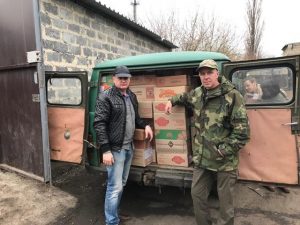
Дитячі лікарі та спеціалісти-дерматологи, які сьогодні у складі команди Першого добровольчого мобільного шпиталю ім. Миколи Пирогова прибули з Києва до Попасної на Луганщині, привезли з собою подарунки до Великодня, а також дерматологічні ліки. Про це повідомив Дмитро Вернигор віце-президент і головний лікар ПДМШ. (more…)